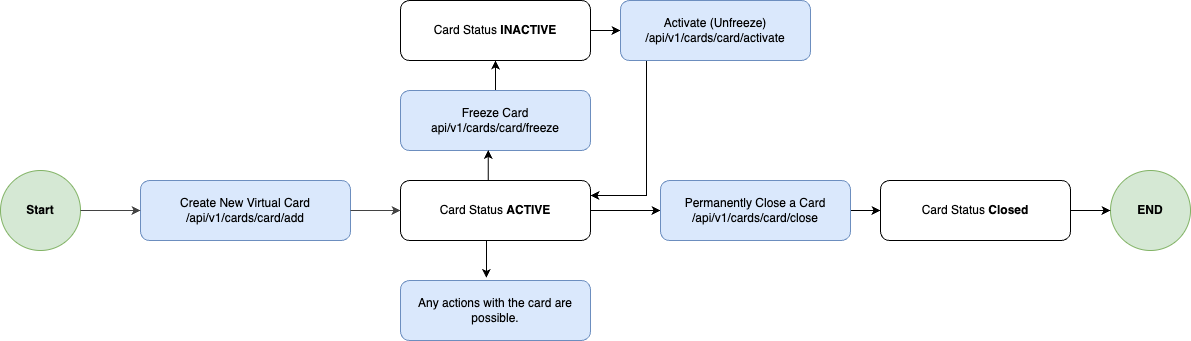
Card Life Cycle
Card Status Model Documentation
The card status model defines various states a card can possess, each indicating the card's current operational status. Understanding these states is crucial for managing card functionalities and user interactions. Below is a detailed explanation of each status:
ACTIVE Status
- Description: The card is active and fully operational.
- Implications: Transactions can be performed without any restrictions. The cardholder can use the card for purchases, withdrawals, and other standard banking operations.
- Endpoint Interaction: No specific endpoint interaction is required for an active card unless there is a need to change other card attributes or block the card temporarily.
INACTIVE Status
- Description: The card is inactive, meaning it is temporarily frozen.
- Implications: While in this state, the card cannot be used to make payments or withdraw. It is essentially in a suspended mode to prevent any transactions.
- Endpoint Interaction:
- Activate (Unfreeze) an 'INACTIVE' Card: To change the status from INACTIVE to ACTIVE, use the designated endpoint. This action unfreezes the card, restoring its functionality for transactions.
- Endpoint Example:
- Endpoint:
POST /api/cards/activate - Purpose: Activates an inactive card, enabling all regular card operations.
- Endpoint:
CLOSED Status
- Description: The card has been permanently closed.
- Implications: A closed status is terminal and irreversible. The card cannot be reactivated or used for any further transactions.
- Endpoint Interaction: No endpoint interactions are available for a closed card as it is no longer functional. This status is final, and any attempt to use or reactivate the card will be rejected.
Card Life Cycle